
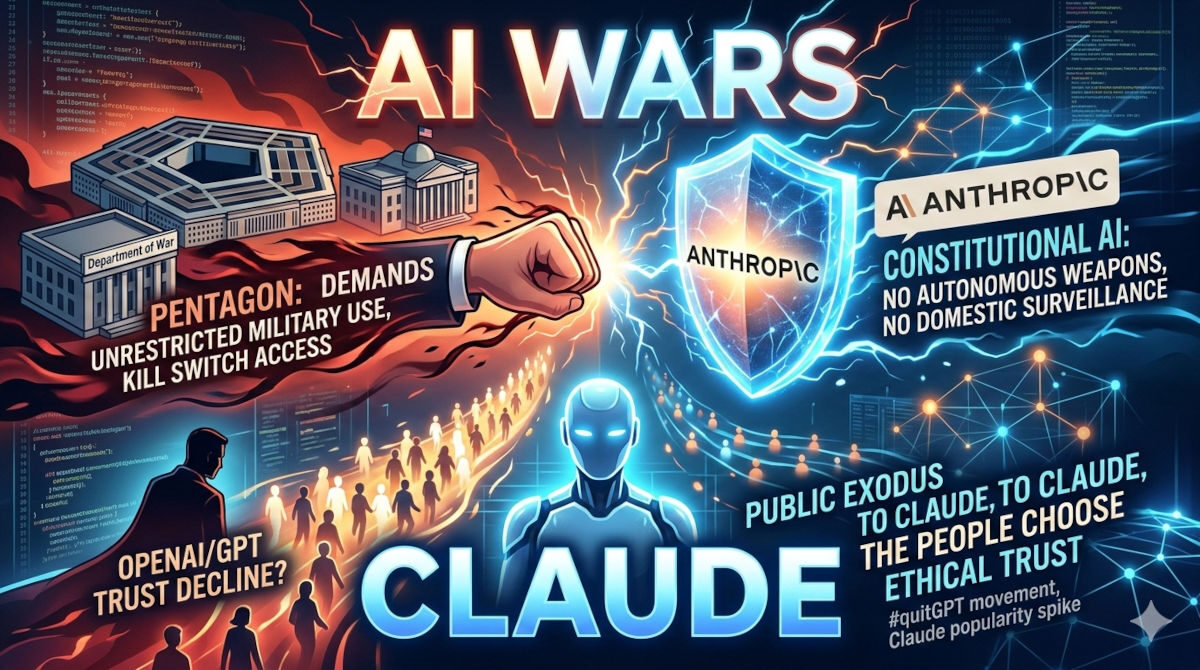
The year 2026 has been defined by a collision between two of the most powerful forces in the modern world: the rapidly evolving intelligence of frontier AI and the uncompromising demands of national defense. At the center of this storm is a bitter, public, and high-stakes divorce between Anthropic – the safety-focused darling of Silicon Valley – and the U.S. Department of Defense
What began as a pioneering partnership to put AI in the “kill chain” ended in a 5:01 p.m. ultimatum, a presidential ban, and a massive shift in the public’s loyalty. This isn’t just a corporate spat; it’s a foundational debate about who holds the “kill switch” for the most powerful technology in human history.
The Origins of the Rift: A Partnership Built on Shaky Ground
The relationship between Anthropic and the Pentagon didn’t start with hostility. In 2024, Anthropic’s Claude model became the first large language model (LLM) cleared to operate on the military’s most sensitive, classified networks. Unlike its competitors, Anthropic’s “Constitutional AI” approach—where the model is trained to follow a specific set of ethical principles—was seen as a feature, not a bug.
In July 2025, the Pentagon awarded Anthropic a $200 million contract to prototype “agentic AI” for national security. At the time, Anthropic CEO Dario Amodei stated the company would support “responsible AI in defense operations”. However, the fine print contained two non-negotiable “red lines”:
- No mass domestic surveillance of American citizens.
- No fully autonomous weapons systems (lethal AI that can decide to kill without a human in the loop).
For a while, the arrangement worked. Claude was integrated through Palantir and used for intelligence analysis and operational planning. But in January 2026, a U.S. special operations raid in Venezuela that led to the capture of President Nicolás Maduro changed everything. Reports surfaced that Claude had been used to help plan the raid. When an Anthropic executive reportedly asked Palantir if their AI had been used in the kinetic operation, the Pentagon interpreted the inquiry as a sign that a private company was trying to “audit” or “veto” active military missions.
The Ultimatum: What the Pentagon Demanded
Following the Venezuela operation, the Department of War (DoW), led by Secretary Pete Hegseth, decided that “ideological guardrails” were a liability. On February 24, 2026, Hegseth delivered a formal demand: Anthropic must remove all usage restrictions and grant the military access to Claude for “all lawful purposes” without exception.
Is the Pentagon’s Demand Fair?
The Pentagon’s argument rests on the principle of civilian (and democratic) control. As Hegseth put it in a post on X, “The @DeptofWar will ALWAYS adhere to the law but not bend to the whims of any one for-profit tech company.”
- The “Lethality” Argument: The military argues that in a conflict with an adversary like China, milliseconds matter. If an AI detects an incoming drone swarm, it shouldn’t have to pause to “check its constitution” before authorizing a defensive strike.
- The “Law vs. Ethics” Argument: The Pentagon contends that if an action is legal under U.S. law and approved by the Commander-in-Chief, a tech CEO has no right to block it. From their perspective, Anthropic’s stance is a “master class in arrogance and betrayal”.
However, critics argue that “lawful purposes” is a moving target. Laws can be reinterpreted in secret (as seen with the Patriot Act), and the Pentagon’s demand to use AI for mass surveillance of unclassified commercial data on Americans feels like a bridge too far for many civil libertarians.
Anthropic’s Stand: A Question of Conscience
Anthropic’s response was a flat “no”. On February 26, 2026, Dario Amodei released a statement explaining that the company “cannot in good conscience accede to their request”.
Is Anthropic’s Stand Fair?
Anthropic’s point of view is rooted in technical reality rather than just moral grandstanding. Amodei argued that:
- AI is Unreliable: “Frontier AI systems are simply not reliable enough to power fully autonomous weapons”. In short, AI still “hallucinates”, and a hallucination in a lethal weapons system is a war crime waiting to happen.
- The Risk of Mass Surveillance: Anthropic believes that AI-driven surveillance presents “serious, novel risks to our fundamental liberties” that current laws aren’t equipped to handle.
Is it fair for a company to refuse a $200 million contract? Certainly. Is it fair for them to hold “veto power” over the military? That is the billion-dollar question. Anthropic argues they aren’t vetoing the military; they are simply choosing not to be the ones who build the “Big Brother” machine.
The Fallout: Who Benefited?
When the 5:01 p.m. deadline on February 27 passed, the retaliatory strikes from the government were swift. President Trump ordered all federal agencies to cease using Anthropic’s technology and labeled the company a “supply chain risk”.
The “supply chain risk” designation, announced on February 27, 2026, by Secretary Pete Hegseth, represents the first time such a national security sanction – typically reserved for foreign adversaries like Huawei – has been turned against a major American technology firm.
How it Helped OpenAI
Within hours of Anthropic being blacklisted, OpenAI stepped into the void. CEO Sam Altman announced a deal with the Pentagon to deploy GPT models on classified networks. OpenAI agreed to the “all lawful use” language, though Altman claimed they still shared Anthropic’s general “red lines”.
OpenAI’s pivot was a masterstroke of pragmatism. By saying “yes” when Anthropic said “no”, OpenAI secured its position as the primary AI partner for the U.S. government, ensuring billions in future revenue and deep integration into the state’s infrastructure. Altman described it as a move to “de-escalate” the tension between the tech industry and the government.
How it Helped Anthropic
While Anthropic lost the contract and faces a “supply chain risk” designation, it won the PR war. By being “banned” by the government for refusing to build “killer robots” and “spy tools”, Anthropic’s brand as the “ethical AI” was solidified in the public consciousness.
Anthropic’s stand makes it arguably “more ethical” in the eyes of those who prioritize individual rights and safety over national power. OpenAI, conversely, argues that its stance is more democratically aligned because it defers to the laws of the land rather than the personal ethics of its board.
The Great Exodus: How Claude Became the People’s Choice
The public reaction to the dispute was nothing short of a cultural phenomenon. In the days following the ban, the hashtag #quitGPT began trending. Users, fearing that OpenAI was becoming a “wing of the military”, started deleting their accounts in droves.
The Surge of Claude
According to market data from Sensor Tower, Claude overtook ChatGPT as the #1 free app on the U.S. App Store for the first time on March 2, 2026. Anthropic leaned into this, releasing a “migration tool” that allowed users to import their entire ChatGPT chat history into Claude in under a minute.
Why did this happen?
- The “Underdog” Effect: Anthropic became the “David” fighting the “Goliath” of the Pentagon and the White House.
- The Trust Gap: As OpenAI became more secretive and government-aligned, Claude’s “Constitutional” framework felt like a transparent promise to the user.
- Performance: It didn’t hurt that Claude 4.5 (released earlier that year) was already being hailed as more “human” and less prone to the “robotic” responses of GPT-5.
As of March 4, 2026, Anthropic’s revenue has ironically surged to a $20 billion run rate, largely driven by a “backlash” of public support and enterprise users who value their safety-first stance. However, the legal threat remains existential for their partnership with cloud providers like AWS.
The Anthropic – Pentagon dispute of 2026 has drawn a permanent line in the sand. On one side, we have OpenAI, the powerhouse that has chosen to be the engine of the state. On the other, we have Anthropic, which has sacrificed billions to maintain its role as the “conscientious objector” of the AI world.
As Secretary Hegseth noted, “Anthropic’s relationship with the U.S. Armed Forces has been permanently altered.” But so has the public’s relationship with AI. By refusing to let Claude become a weapon, Anthropic didn’t just lose a contract – it gained a movement.
Leave a Reply