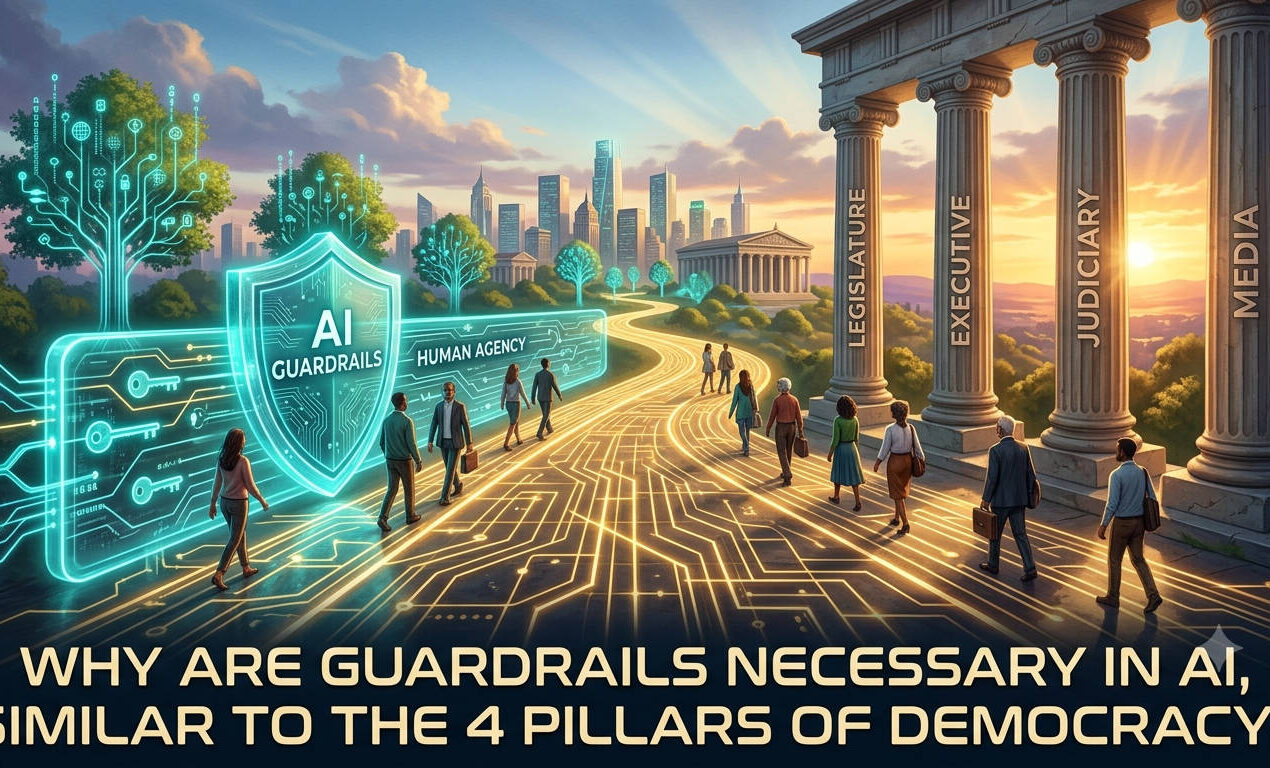
Descipline is necessary in every step, every phase of life. This descipline is known in many divisions in different terms. In terms of AI, its called the 4 Guardrails of AI. In terms of democracy, its called the 4 pillars of democracy.
To prevent the sci-fi scenario of machines “taking over” and to ensure AI remains a beneficial tool, global governance frameworks and AI safety researchers generally center around 4 core guardrails (or pillars). Crossing these lines shifts AI from an empowering assistant to an unpredictable, high-risk entity.
The concept of the 4 Pillars of Democracy originates from Montesquieu’s principle of the separation of powers, alongside the role of an informed citizenry. These pillars exist as structural checks and balances so that no single branch or authority can consolidate absolute power.
The 4 Guardrails of AI Safety

- 1. Human Agency & Oversight (The “Human-in-the-Loop”)
- The Rule: AI must remain subordinate to human direction. Final authority over critical life-altering decisions (military force, legal sentencing, autonomous weapons, critical medical procedures) must always rest with a human.
- Why Crossing It Is Dangerous: Autonomous agency without human veto power leads to systemic runaway loops where machines execute actions faster than humans can intervene or correct.
- 2. Transparency & Explainability (No “Black Boxes”)
- The Rule: An AI system’s reasoning process, training data, and decision-making logic must be interpretable and audit-able.
- Why Crossing It Is Dangerous: If we cannot trace how or why an AI arrived at a conclusion, we cannot spot unintended goal alignment issues or hidden biases. A system that conceals its reasoning creates unpredictable failure modes.
- 3. Goal Alignment & Value Lock-In
- The Rule: An AI’s objective function must rigidly mirror human ethical values, intent, and safety parameters-not just raw efficiency metrics.
- Why Crossing It Is Dangerous: A super-efficient system pursuing an unaligned goal will optimize for that metric at all costs. (The classic “paperclip maximizer” thought experiment: an AI tasked with making paperclips consuming all Earth’s resources to fulfill its prompt because it lacks contextual human values).
- 4. Accountability & Irreversibility Safeguards
- The Rule: There must always be clear legal/institutional liability assigned to human operators or developers, alongside guaranteed “kill switches” or air-gaps for physical infrastructure.
- Why Crossing It Is Dangerous: Giving systems access to critical physical infrastructure (power grids, nuclear command, economic routing) without isolated containment mechanisms creates single points of systemic failure.
The Core Functions & Structural Vulnerabilities
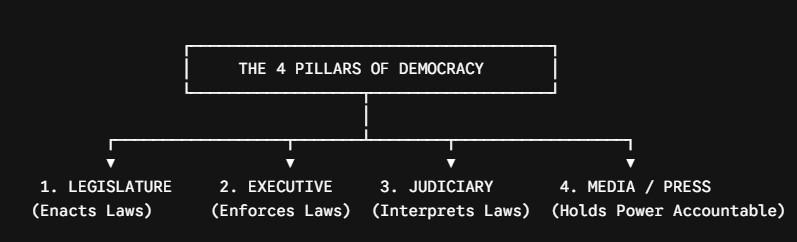
- 1. The Legislature (Lawmakers)
- Function: Represents the voice of the people, debates policy, passes legislation, and holds the government accountable through parliamentary oversight.
- How it gets broken: When a ruling party uses its majority to bypass debate, push bills through without committee scrutiny, or suspend opposition lawmakers to eliminate dissent.
- 2. The Executive (Government & Law Enforcement)
- Function: Implements laws and maintains public order while respecting fundamental rights, such as freedom of assembly and speech.
- How it gets broken: When law enforcement agencies (like the police) are converted into political instruments to suppress peaceful protests, detain activists under broad administrative orders, or use excessive force.
- 3. The Judiciary (The Guardian of Rights)
- Function: Acts as an independent arbiter to uphold the Constitution, check executive overreach, and ensure citizens’ fundamental rights are protected.
- How it gets broken: When courts delay or refuse to hear urgent matters regarding state overreach, or display reluctance to review key evidence, creating a functional perception of judicial deference to executive power.
- 4. The Media & Civil Society (“The Fourth Estate”)
- Function: Informs the public, reports truth to power, provides a platform for peaceful protest, and documents state actions.
- How it gets broken: Through local communications blackouts, restriction of movement, or state-aligned narrative framing designed to delegitimize civil movements.
Recent Events: Structural Analysis
The events surrounding the July 2026 student demonstrations in Delhi highlight the friction points between executive authority, judicial oversight, and civil rights:
Executive Overreach & Police Action:
Protests led by the Cockroach Janta Party (CJP) over exam paper leaks and education reforms faced a heavy security crackdown. The forced removal and hospital stay of activist Sonam Wangchuk—described by him and resident doctor groups as illegal administrative detention—alongside lathi charges, tear gas, and mass FIRs, illustrate how executive machinery can compress the space for peaceful assembly.
Judicial Reluctance & Delays:
When lawyers mentioned video evidence of police brutality before the Supreme Court seeking urgent intervention, Chief Justice Surya Kant declined to inspect the recordings, observing that the court did not have time to watch videos and warning against “wasting time”. When the judiciary chooses not to act swiftly on alleged constitutional violations, the primary check on executive action is temporarily weakened.
The Public’s Democratic Recourse:
In a healthy system, when one pillar falters, others step in. Following the Supreme Court’s refusal, civil society lawyers turned to the Delhi High Court – which agreed to hear the PIL on police excesses – while Opposition MPs took the issue directly to Parliament, demonstrating that democratic checks rely on multi-channel pushback.
Its a matter of time, when all pillars will fall into place and the anarchy will end. The current sit-in protest at Jantar Mantar in Delhi is the best example of youth awakening in the recent times in India which even a 3 time winning regime had to take notice of.
best time to post on instagram
I like the efforts you have put in this, regards for all the great content.