
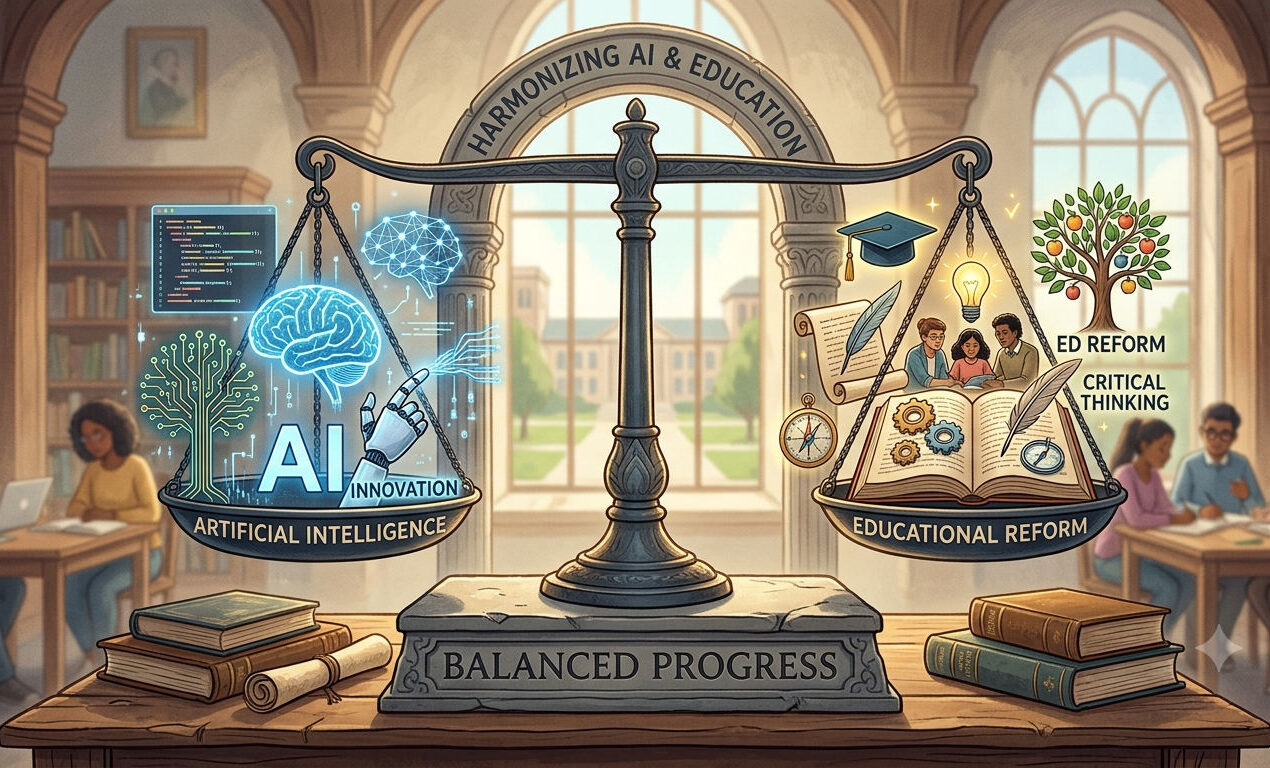
Is artificial intelligence a greater threat to the next generation than the evolving frameworks of modern school systems? This analytical article explores the critical debate surrounding global youth prospects, comparing the economic disruptions of automated job displacement against structural challenges within national education policies. Discover how the emergence of the AI generalist and the urgent need for professional reskilling intersect with complex policy realities in countries like India and the US – ranging from curriculum shifts and administrative exam leaks to regional civic protests. Read on to understand how technology and state governance shape tomorrow’s workforce.
Navigating Tomorrow: Assessing the Structural Impacts of Technological Evolution and Educational Policy
The contemporary global landscape is defined by two powerful forces shaping the trajectory of the next generation: the rapid advancement of artificial intelligence (AI) and the systemic frameworks established by national education policies. In prominent nations such as the United States and India, both dimensions present unique transformations, opportunities, and underlying institutional frictions. While technological disruption alters market demands overnight, the mechanisms of formal schooling, curriculum design, and state administration dictate how prepared citizens are to face these updates. Evaluating which force presents a greater challenge requires an objective examination of labor economics, institutional accountability, and the shifting paradigms of civic engagement.
The Double-Edged Sword of Artificial Intelligence: Displacement and Reskilling
Artificial intelligence represents a fundamental shift in production capabilities, leading to structural anxieties regarding employment. Automation is no longer confined to routine, manual labor; advanced machine learning algorithms now perform complex data analysis, content generation, and administrative tasks. This transition has naturally resulted in localized job displacement across technical and support sectors globally. For individuals whose roles are automated, the short-term economic shock is considerable, creating a pressing demand for transitional support systems.
Conversely, the narrative of automation is historically counterbalanced by the phenomenon of job creation. The burgeoning AI ecosystem demands new roles in data engineering, algorithmic oversight, ethical governance, and system implementation. However, realizing these opportunities depends entirely on the workforce’s ability to reskill. The concept of the ‘AI generalist’ has emerged as a crucial bridge – professionals who possess a broad understanding of technological capabilities alongside domain-specific expertise. These individuals excel at prompt engineering, strategic tech integration, and cross-disciplinary collaboration, creating substantial upward mobility for populations possessing agile, adaptive learning mindsets.
Educational Restructuring and Global Competitiveness
While technology evolves fluidly, national education policies change through deliberate legislative cycles. In both India and the United States, recent policy updates aim to modernize learning but have encountered significant scrutiny regarding implementation. The primary challenge lies in whether standardized, state-mandated frameworks can keep pace with an exponential market environment. Critics argue that rigid curricula, over-reliance on high-stakes testing, and centralized control can limit the development of critical thinking, leaving youth vulnerable to economic shifts.
In addition to structural alignment, the social environment within educational institutions plays a decisive role in youth outcomes. Societal polarization, discrimination, and targeted social friction within communities inevitably affect educational access and psychological well-being. When systemic biases influence academic environments, they restrict the equitable distribution of resources, thereby dampening the collective potential of diverse student bodies. Ensuring inclusive environments remains a critical benchmark for the success of any national educational policy.
Administrative Vulnerabilities and Institutional Accountability
Beyond conceptual policy design, the operational integrity of educational systems significantly shapes public trust and youth prospects. In developing academic ecosystems, administrative lapses such as systemic exam paper leaks pose severe challenges. When competitive examinations are compromised, it introduces non-accountability that penalizes merit, delays career progression, and induces widespread disillusionment among students who invest years in preparation. Addressing these security and administrative vulnerabilities is essential for preserving the credibility of public education systems.
Simultaneously, educational content itself frequently becomes a subject of state-level negotiation. The modification of historical narratives within school textbooks to align with prevailing governance perspectives is a recurring subject of debate in both Western and Eastern hemispheres. While governments often frame curriculum revisions as efforts to streamline content or emphasize national heritage, independent analysts express concern over the potential loss of historical nuance. A balanced curriculum is widely viewed as necessary for cultivating analytical citizens capable of evaluating complex historical contexts.
Civic Engagement, Protests, and the Democratic Process
The intersection of youth prospects, governance, and public policy naturally extends to the arena of civic expression. In democratic societies, the right to peaceful protest is an established mechanism for citizens to voice grievances regarding policy directions. Recent movements involving public figures and activists, such as Sonam Wangchuk’s advocacy for environmental and constitutional protections in Ladakh, or digital commentary by observers like Abhijeet Dipke, illustrate the evolving nature of civic discourse. These actions underscore the ongoing dialogue between civil society and democratically elected governments regarding regional autonomy and policy accountability.
Youth Movements & Satirical Activism
As the mediums for public expression shift from physical squares to digital platforms, the dynamics of protest face structural changes. Discover how contemporary youth coalitions are responding to systemic challenges by visiting the Twitter feed of the Cockroach Janata Party, detailing the formation of this satirical student-led movement. The interaction between state authorities, public administration, and diverse citizen coalitions reflects the natural tensions inherent in democratic governance. Maintaining open, institutionalized channels for feedback and dissent is essential to ensure that policy frameworks adapt constructively to the actual needs of the populace, minimizing systemic alienation among the youth.
Public Dialogue & Operational Frictions
For updates regarding civic actions at Jantar Mantar and reactions from public administration, review the coverage provided by the Times of India Report on Jantar Mantar Civic Agitations.
In conclusion
Determining whether artificial intelligence or contemporary educational policies pose a greater challenge to society reveals an interconnected reality. AI introduces rapid, external technological shocks to the economy, demanding continuous adaptation and reskilling. Educational policies, on the other hand, build the internal foundation of a nation’s human capital. When educational systems suffer from rigid structures, administrative lapses, or socio-political polarization, they weaken the citizenry’s capacity to navigate technological shifts. Ultimately, technological advancement and policy formulation are not independent variables; rather, the resilience of tomorrow’s youth depends on building accountable, inclusive, and adaptive institutions capable of harmonizing both.
For real-time coverage detailing the intersection of public administration, student demands, and recent civic movements, view this CNN-News18 Report on Jantar Mantar Demonstrations which documents the recent unfolding events concerning public protests over competitive exam accountability.
Leave a Reply