
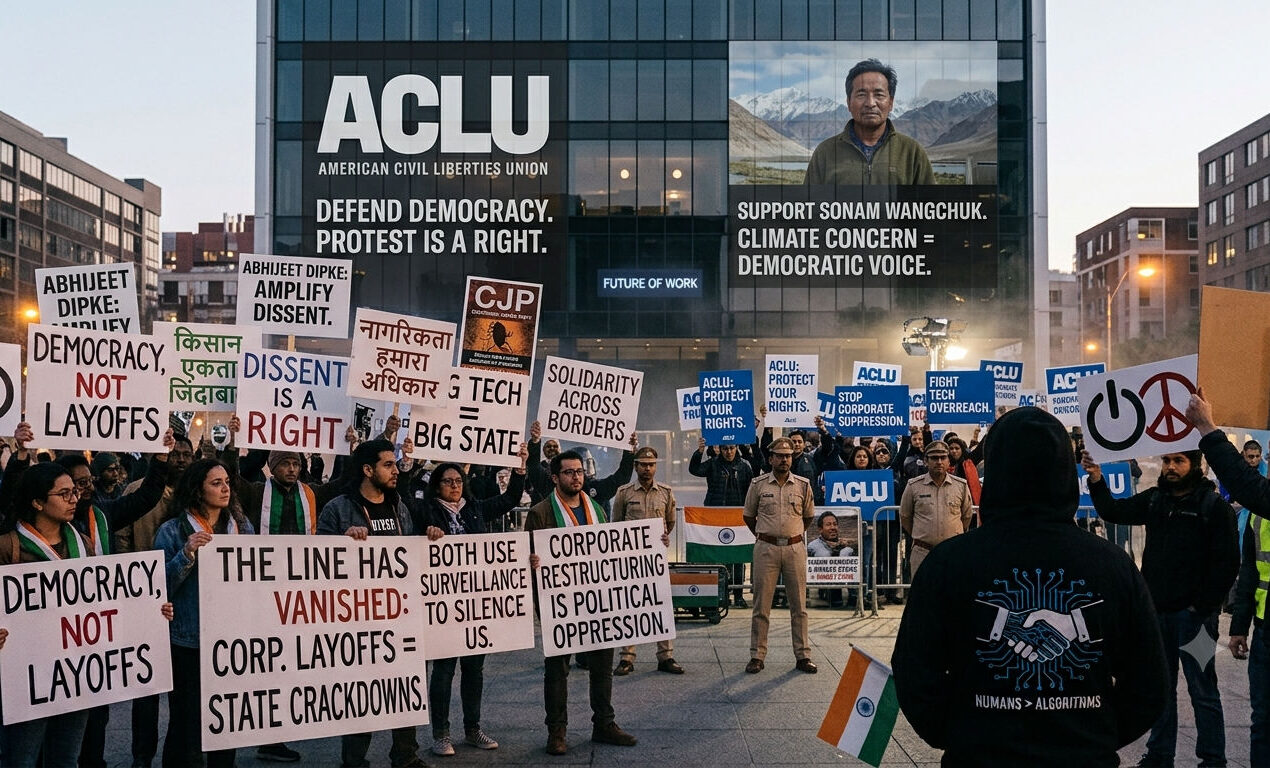
The line between the corporate floor and the public square hasn’t just blurred. It has been erased.
We live in an era where losing your livelihood is masked as an “agile transformation,” while standing up for your rights is treated like a public nuisance. If you look closely at the mechanics of 2026, a terrifying parallel emerges between how Big Tech handles its workforce and how modern states handle dissent.
We recently spoke about what is more harmful – AI or central education policy.
Let’s talk about the illusion of choice, the myth of the “cut,” and how the elite are using the exact same playbook to silence you – whether you’re staring at a Slack termination notice or a police barricade.
Part 1: The Great Tech Layoff Propaganda
We were told 2024 was the peak. Then 2025 came. Now, midway through 2026, the tech industry has already erased over 120,000 jobs globally.
Look at the latest corporate announcements cascading across X (formerly Twitter). Cisco just slashed another 4,000 roles to pivot toward “AI-driven networking”. Accenture is executing a massive restructuring of 11,000 roles, with their leadership openly stating, “those we cannot reskill will be exited”. Even law firms like Baker McKenzie are cutting up to 10% of their workforce.
Check the reality of these announcements directly from the source:
But here is the absolute propaganda of it all: These layoffs are not about cost-cutting.
These companies are bringing in record revenues. They are swimming in capital. The truth is, these layoffs are a forced, top-down mechanism for reskilling and automation re-alignment. They dump thousands of experienced workers under the guise of “AI efficiencies,” only to quietly turn around and post identical job listings for “AI-fluent” variants a quarter later.
According to industry data, nearly half of the companies that aggressively cut headcount due to AI are already rushing to rehire. They didn’t lack money; they wanted to strip you of your leverage, reset your wage baseline, and bring in a fresh batch of workers who won’t question the new workflow.
In the corporate world, if management doesn’t like the current human dynamic, they hit the delete button. They replace the collective memory of the workforce with a line item in an AI budget.
Part 2: The Democratic Protest – The Last Un-deletable Space?
Now look at the opposite side of the mirror: How protests work in a genuine democracy.
In a healthy democracy, a protest is the ultimate pushback against a forced “restructuring” of society. It is an integral, non-negotiable feature. When a government pushes a policy that breaks the social contract, citizens cannot simply be “laid off.” They assemble.
Unlike a corporate ecosystem, the core tenet of a democratic protest is that leadership cannot legally or forcibly stop it. A CEO can revoke your server access at 9:00 AM, stripping your right to reply. A democratic state, bound by a constitution, is supposed to protect your right to stand on the pavement, hold a placard, and demand accountability.
But what happens when the state starts acting like a Silicon Valley board of directors?
Part 3: The Global Playbook of Suppression
If you think this algorithmic suppression of human voice is isolated to one region, you are missing the global picture. The playbook is identical, whether it is deployed by an autocrat or a Western executive branch.
Case A: The Mass Deportation Protest Crackdowns (USA)
Look across the Atlantic under the current Trump administration. As federal immigration enforcement operations under “Operation Midway Blitz” and widespread mass deportation raids intensified across major American metro areas, millions of citizens took to the streets in the massive “No Kings” protest movement. The response from the administration wasn’t democratic dialogue – it was a coordinated, tactical shutdown. In Los Angeles and Seattle, local and federal law enforcement agencies used chemical irritants, pepper balls, and batons to forcibly disperse thousands of peaceful demonstrators. Reports from groups like Physicians for Human Rights have documented over 400 unique incidents of law enforcement misusing dangerous crowd-control weapons against protesters and journalists just to clear the streets.
Case B: The Crackdown at Jantar Mantar (India)
Now look at what has been happening simultaneously in the heart of New Delhi at Jantar Mantar.
For weeks, the Cockroach Janta Party (CJP) – a movement born out of sheer defiance against institutional arrogance—has been protesting alongside student bodies demanding systemic accountability over catastrophic national exam leaks. The stakes skyrocketed when legendary Ladakhi climate activist and education reformer Sonam Wangchuk joined the protest, launching an indefinite hunger strike.
Wangchuk, a man who has dedicated his life to sustainable innovation, lost significant body weight while fighting for the future of the nation’s youth. The system’s response? It didn’t engage in dialogue. It used corporate tactics.
In the wee hours of the morning, Delhi Police launched a sudden crackdown, forcibly removing a frail, fasting Sonam Wangchuk from the protest site and placing him under effective isolation at Safdarjung Hospital. To make matters more dystopian, authorities deployed intrusive surveillance towers and systematic videography to log the faces of every single student protester at the site.
Has the Line Disappeared?
When a tech company uses algorithms and strategic redundancies to isolate and remove workers who don’t fit its immediate bottom line, we call it corporate restructuring.
When a modern state uses midnight crackdowns, high-tech surveillance towers, rubber bullets, and forced hospital isolation to remove peaceful activists from a historic public square, what do we call that?
The line hasn’t just blurred – the tactics have merged.
The state is treating its citizens exactly how tech companies treat their employees: as dispensable, over-hired capital that can be managed, suppressed, and phased out when they demand accountability. The forced removal of an activist in Delhi or the deployment of federal tactical teams against protesters in Los Angeles is the democratic equivalent of getting locked out of your corporate Slack channel in the middle of the night.
If leadership, whether in a glass tower in San Francisco or a seat of government in Washington or New Delhi, can forcibly deny your right to exist in the room where decisions are made, then we are no longer talking about a democracy. We are talking about a global corporate state where dissent is just a bug to be patched in the next software update.
Wake up. You can’t code your way out of a broken system, and you can’t log out of a cracked-down street.
Leave a Reply