
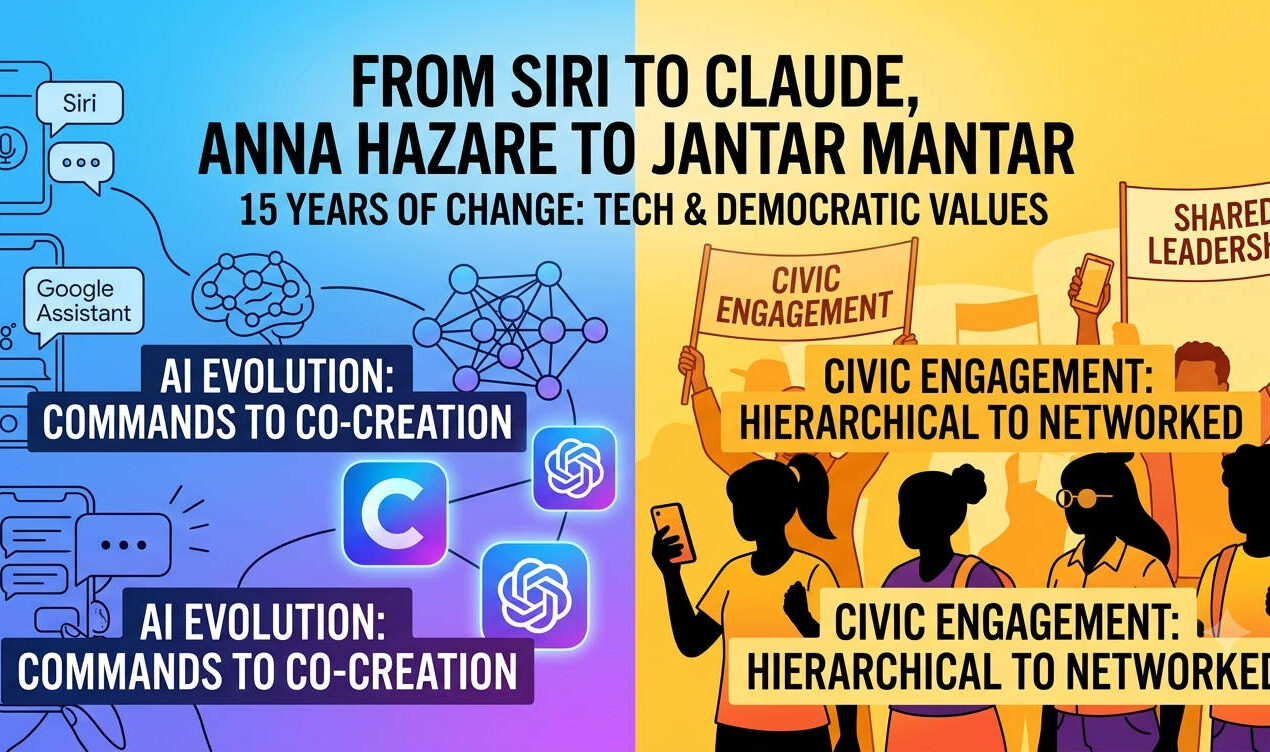
If you had told my 20-year-old self back in 2011 that one day I’d be discussing complex code refactoring with a generative AI while watching young students coordinate nationwide civil dialogues via decentralized digital networks, I would have laughed.
Back then, I was a young Millennial navigating my early twenties in urban India. The world around us was shifting under two major catalysts: early smartphone technology and a massive civic awakening. Looking back over the last 15 years, it strikes me how deeply parallel two seemingly different journeys have been – the evolution of Artificial Intelligence and the changing posture of India’s democratic expressions.
The Era of Command & Control (2011–2016)
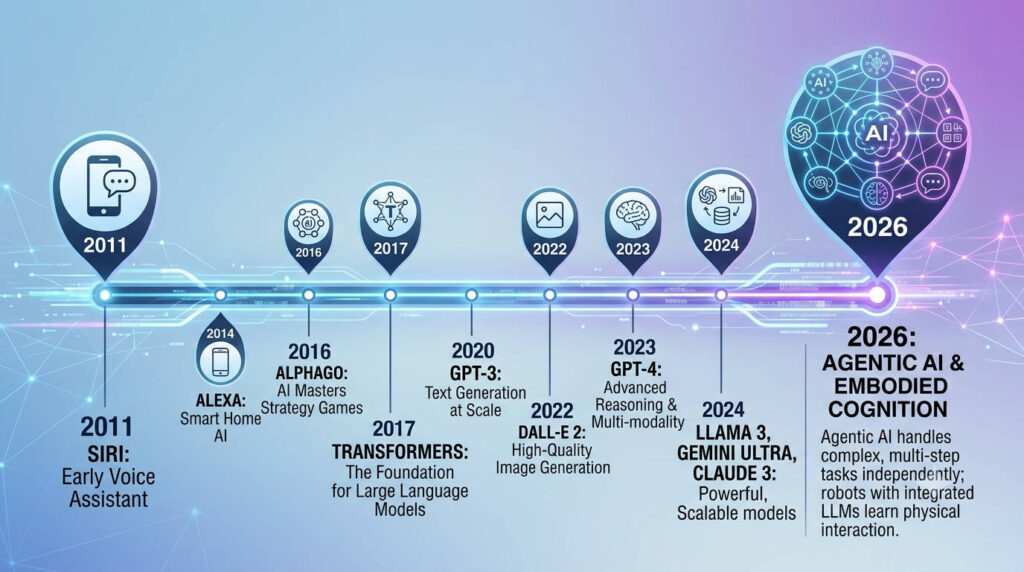
AI’s First Steps: “Siri, Set an Alarm”
Fifteen years ago, consumer AI made its grand mainstream entry. Apple launched Siri in late 2011, followed closely by Google Voice Search and Google Assistant.
In those early days, AI was rule-based, centralized, and reactive. You spoke to a voice assistant, and it executed structured commands:
- Set a timer for 10 minutes.
- Call Mom.
- What is the weather in Delhi today?
It was impressive for its time, but fundamentally rigid. If you ventured slightly off-script, the system fell apart with a polite “Sorry, I didn’t get that.”
Civic Awakening: The 2011 Anna Hazare Movement
Around the exact same time, in April 2011, thousands of us marched to Jantar Mantar and Ramlila Maidan, rallying around Anna Hazare and the India Against Corruption movement.
Like the AI of that era, democratic engagement in 2011 had a central figurehead and a unified command structure:
- Centralized Figure: One major figure (Anna Hazare) serving as the focal point.
- Single Focus: A consolidated, singular demand – the passage of the Jan Lokpal Bill.
- Broadcast Media: Mass gathering fueled largely by traditional TV news broadcasts and early Facebook event pages.
It was structured, top-down, and clear. Citizens looked up to a moral authority to articulate their collective frustration, much like how users relied on rigid software commands to get a response.
The Decentralized Shift (2017–2022)
As the late 2010s unfolded, both technology and public engagement began breaking out of their singular containers.
AI Learns Context
In tech, we moved beyond basic voice commands toward deep learning, natural language processing (NLP), and early predictive models. Google introduced Transformer architectures in 2017 – the “T” in ChatGPT – enabling machines to understand context, relationship, and nuance across vast sequences of information. AI was no longer just responding to a keyword; it was beginning to parse intent.
Civic Expression Diversifies
Simultaneously, civic discourse across India transformed. People stopped waiting for centralized national icons to lead a rally. Localized, issue-specific conversations emerged across college campuses and community forums – fueled by WhatsApp groups, Twitter (X), and Instagram reels. The democratic voice became less about following one central platform and more about distributed participation across everyday issues.
The Generative & Collaborative Era (2023–2026)
AI as a Partner: ChatGPT, Claude, and Beyond
Fast forward to today. The leap from rigid voice assistants to modern Frontier LLMs like Claude, Gemini, and ChatGPT represents a shift in medium and agency:
Today’s AI doesn’t just listen; it collaborates. It helps write software, synthesize complex research, brainstorm creative projects, and analyze data across multiple modalities.
The 2026 Student Movements at Jantar Mantar
In mid-2026, Jantar Mantar once again became the backdrop for youth civic engagement. Student-led demonstrations surrounding public examination reforms (such as the NEET and CBSE revaluation discussions) gathered momentum.
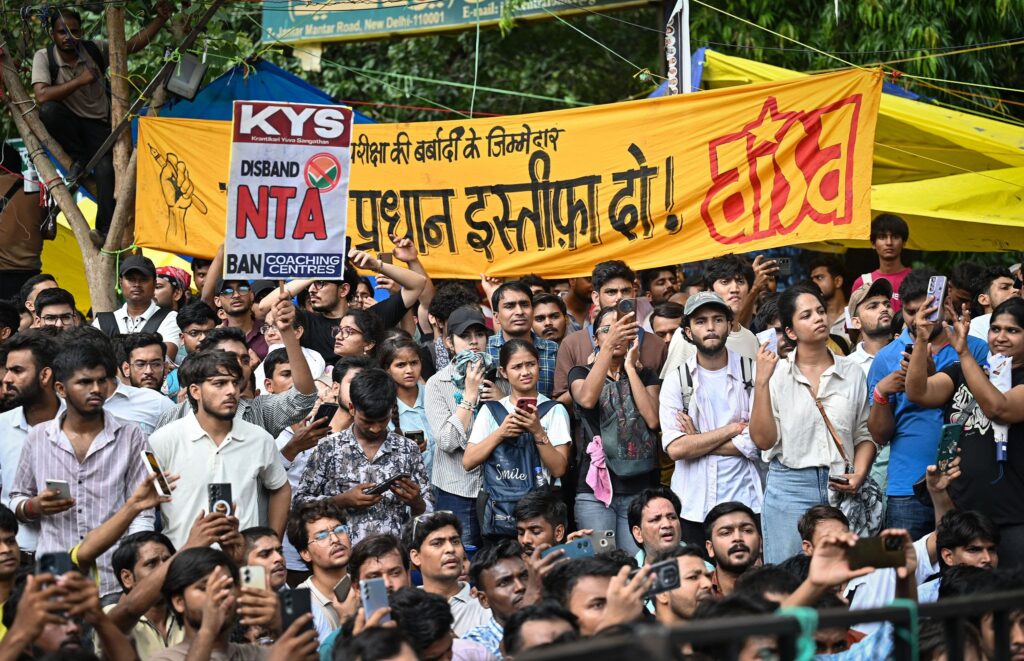
When you look at these modern student gatherings alongside the 2011 movement, the cultural and structural evolution becomes clear:
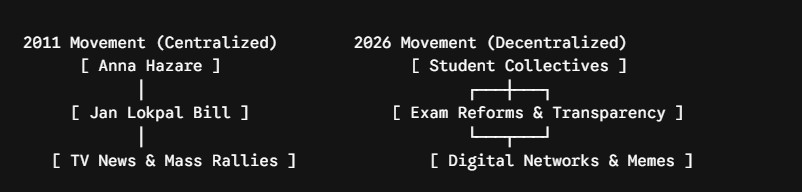
- From Hierarchical to Networked: Rather than waiting for a single, senior leader, Gen Z students leverage peer-to-peer networks. Modern movements feature horizontal, shared leadership across various youth collectives.
- From Mono-Slogans to Meme Culture: The language of expression evolved from formal petitions to creative satire, viral memes, and interactive social streams. Satire and digital art serve as tools to translate dense policy demands into accessible public dialogue.
- From Singular Bills to Systemic Questions: While 2011 focused primarily on a single legislative act, 2026 youth discussions emphasize institutional accountability, process integrity, and transparent governance systems.
Parallel Trajectories: A Reflection
As a Millennial who stood at Jantar Mantar in 2011 with a basic smartphone and now prompts advanced language models for daily work, the comparison feels deeply organic:
The Underlying Principle: Both technology and democratic engagement shifted away from centralized output toward distributed participation.
- Agency Has Expanded: In 2011, we asked AI to do a task for us, and we asked a leader to represent us. In 2026, we co-create with AI systems, and young citizens self-organize their own civic narratives directly through real-time media.
- Context Over Keywords: Early AI needed exact words; modern LLMs grasp nuance. Similarly, public participation moved past binary “yes/no” demands toward nuanced discussions around institutional transparency and systemic access.
The journey from Siri to Claude isn’t just a story about microchips and data centers; it’s a story of human capability expanding through better tools. And the journey from 2011 to 2026 shows a generation learning to use those tools to make their voices heard, directly and creatively.
best time to post on instagram
Nice post. I learn something totally new and challenging on websites
best time to post on instagram
Nice post. I learn something totally new and challenging on websites